Is a Box of Old Toys Worth Anything? A Ten-Minute Check
A practical triage for a box of old toys: what to look for, how to check sold prices yourself, when to stop and call a specialist, and why most played-with toys are worth little.
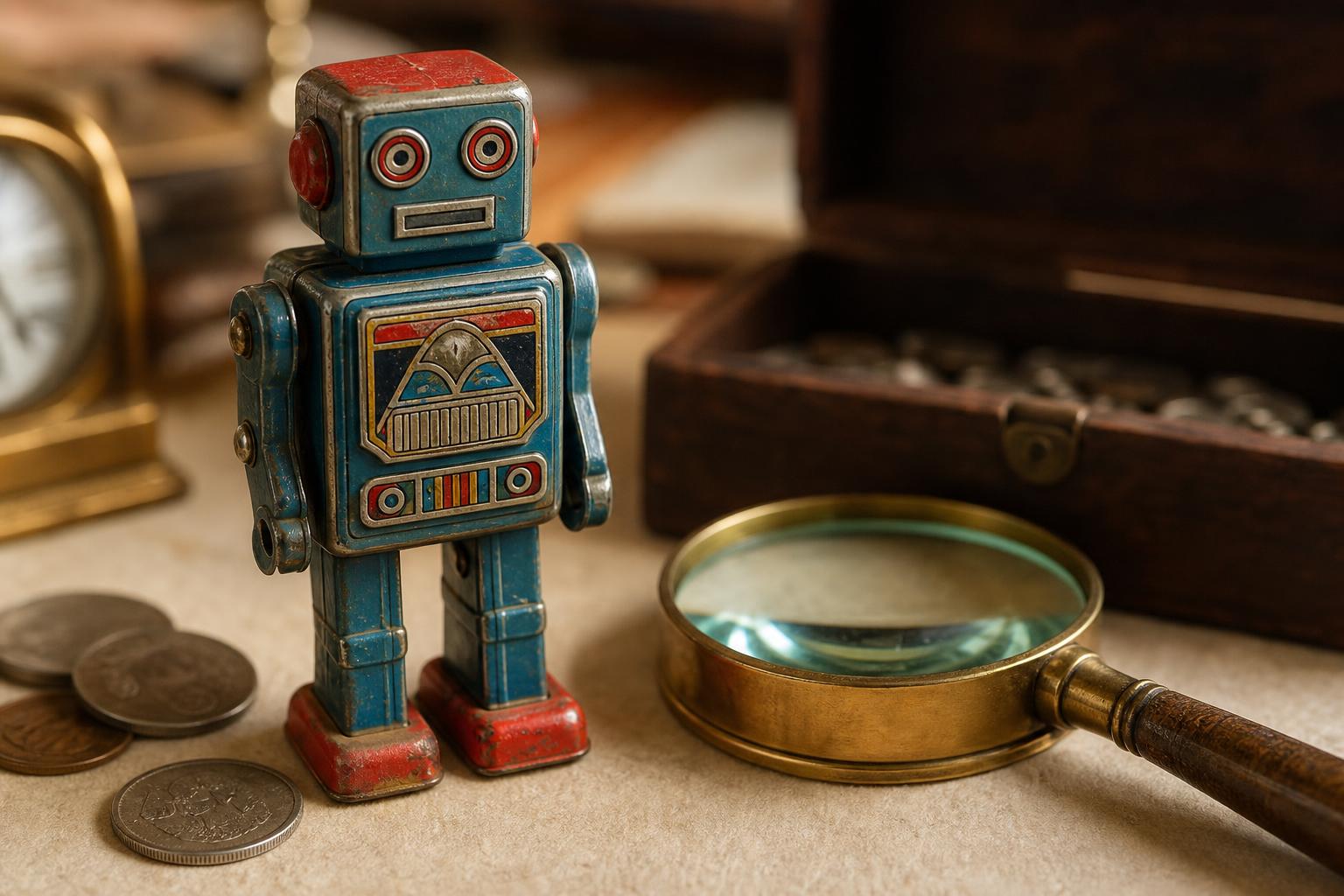
The honest starting point
Most toys that were played with are worth little. They were made in large numbers, and wear, missing parts and lost packaging take away most of what a collector pays for. A small share are worth real money, and those can usually be spotted quickly if you know what to look at.
This is a sorting method. It tells you which items deserve a proper look, and it is not an appraisal.
Before you touch anything
- Do not clean, repair or repaint anything.
- Do not open sealed packaging.
- Do not throw away boxes, inserts, instructions, catalogs or bags of small parts. Packaging and paperwork can matter as much as the toy.
- Keep things that were stored together, together.
Minutes 1 to 3: make three piles
Still packaged. Sealed boxes, figures still attached to their cards, and opened boxes that still have their inserts and instructions.
Loose but looks complete. Older toys in good shape with their accessories: a figure with its weapon and cape, a vehicle with all its doors and wheels, a doll in its original outfit.
Everything else. Broken or incomplete toys, fast-food giveaways, unbranded toys, and anything heavily worn.
The first pile is where value is most likely. The third is where it is least likely, though it is worth a glance for the things in the next section.
Minutes 3 to 6: read the markings
Turn each item in the first two piles over. Look on the underside, the back, the inside of the legs, the back of a doll's neck or lower back, and the base of a vehicle. Use a phone torch held to the side. You are looking for three things.
A maker. Kenner, Hasbro, Mattel, Takara, Marx, Mego, LEGO, Matchbox, Corgi, Dinky, Steiff and similar names mean the toy belongs to a line that collectors follow and that has a record of past sales to compare with. We have step-by-step guides for the lines people ask about most: Kenner Star Wars figures, Hot Wheels Redlines, Matchbox Lesney cars, Corgi and Dinky and early Barbie dolls.
A date. A year next to a copyright symbol is the copyright date. It is the earliest the toy could have been made. Moulds were reused for years, so a figure stamped 1977 may have been made in 1984.
A country. It helps tell versions apart, and later reissues were often made somewhere different from the originals.
No markings at all usually means an unbranded toy or a copy. Very early toys can also be unmarked, so if something looks old and well made, keep it in the pile.
Minutes 6 to 8: completeness and condition
For each marked item, note two things.
What is with it. Small accessories are the first things lost and are often what makes a toy desirable. If you find a tub of loose guns, helmets and capes, keep it; do not throw it out.
What is wrong with it. Breaks, loose joints, worn paint, yellowed plastic, peeling stickers, sun fading, battery corrosion, and on packaging: tears, creases, crushed corners, price stickers and water marks. Our glossary of condition and packaging terms explains the words you will see in listings.
Minutes 8 to 10: check sold prices for your best five
Pick the five most promising items and look up what the same thing has sold for.
eBay sold listings. Search for the maker, line, name and year, then filter the results to show sold items. Prices of things that sold are evidence. Asking prices on unsold listings are only what a seller hopes for. Look at several sales, and compare like with like: a loose figure against loose figures, a sealed one against sealed ones.
Auction house archives. Specialist toy auctioneers such as Hake's, Heritage Auctions and, in the UK, Vectis publish past results. These are the right comparison for sealed, graded or rare pieces.
For LEGO, search by the set number printed on the box and the instructions. If all you have is an unsorted box, see what a box of mixed LEGO is worth.
If the sold prices for an item are small, it is safe to assume the rest of that kind are too, and you can stop checking them one by one.
Signs an item deserves a closer look
- Sealed or carded packaging from the 1960s to the 1980s
- A complete toy with all its small accessories from a line collectors follow
- Anything that looks unfinished or unusual: unpainted, hand-painted, wrong colours, no copyright stamp on something otherwise well made
- Paperwork that suggests a previous owner worked for a toy company or shop
- Tinplate, clockwork, cast-metal and pre-war toys, and early stuffed animals with a maker's tag or button
- A large quantity from one line, which suggests a deliberate collection
Signs it is probably worth little
- Loose, worn and missing parts
- Toys sold as "collector's editions" in large numbers, which many people bought and kept boxed
- Fast-food and promotional toys
- Recent toys that are still easy to buy
When to stop and call a specialist
Stop looking things up yourself, and do not sell anything yet, if any of these is true:
- Sold prices for comparable items are high enough that a mistake would matter to you
- You have sealed vintage packaging, or anything that might be a prototype or shop display
- The collection is large and focused on one line
- You need a figure for insurance, probate or a division between family members
For selling, contact a specialist toy auction house and ask whether they will look at photos; how to sell a toy collection compares that route with the others. For insurance or probate, you need a written appraisal from a qualified appraiser, and an online estimate is no substitute for that, ours included.
Write it down as you go
A list of what you found, with photos, is useful whatever happens next. How to catalog a toy collection has a method and a free spreadsheet template.
If you cannot tell what something is, Catalog My Toys can suggest an identification from a photo and give a rough estimate based on current eBay asking prices. Asking prices are not sold prices, so use it to decide what to look up properly. You can try one free scan without an account.